
Introduction
Over the past decade or two, millions of dollars have been spent by electric utilities to develop corporate business-level data glossaries and more technically focused data dictionaries. But very few of the projects charged with developing such tools investigated the completely free, open-source electric utility data known as the Common Information Model, or CIM. The CIM was developed by electricity industry experts for use by the electricity industry, and covers data used from the largest investor-owned utility to the smallest rural cooperative, representing data related to generation, transmission, distribution and, yes, even distribution-connected customer energy devices.
The CIM is expressed in Unified Modeling Language (UML) and can represent over 2,000 different utility data objects. Each object is represented by a UML class and has a well-defined definition along with typically multiple data attributes and several relationships to other objects. The model is hierarchical, with some objects being specializations of other objects. For example, a “switch” is one of the CIM classes which is further specialized into fuses, jumpers, reclosers, breakers, and so on. All switches have common attributes including rated current, a normal position, and a position at the present time. Specialized classes add other elements, for example the breaker has a breaking capacity and an in-transit time. All attributes have well-defined types with explicit units-of-measure in avoiding the possibility of misinterpreting the data for each instance of the object.
The ability to create a representation of the power grid was the motivation behind the original CIM development work and the core of many interoperability successes around the world. Because each element of any power system can be represented by one of these objects and because each object has associated terminal objects, the entire power grid can be logically assembled into a networked set of data. With such data as a foundation, any power grid can be described and used as the basis for many internal software solutions, such as planning analysis simulators and real-time grid management tools.
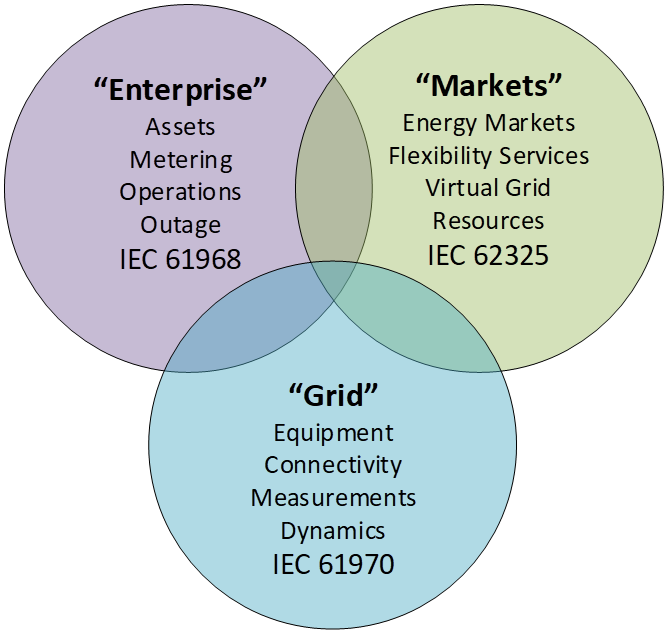
Building upon the grid representation library (which practitioners call the “Grid Package”), an entire library of objects has been established to track the day-to-day operations of an electric utility. The scope of the section of the CIM, entitled the “Enterprise Package” cover many functions across the utility including customer information management, metering and payment, asset management, planned and unplanned outage management, switching operations, and work management. While representations in the Grid Package are often long-lived, for example a switch object might remain unchanged for years, the data in the Enterprise Package is much more dynamic. Tracking individual transactions among utility systems, all with unique identifiers, allows for data correlation and orchestration.
The third section of the CIM was developed to support wholesale electricity markets and was named the “Markets Package,” accordingly. Here market transactions like bids and offers, clearing results, dispatches, and settlement information are all modeled to support energy, capacity, and Essential Reliability Service[1] markets. This modelling also includes the concept of locational marginal pricing and, not surprisingly, ties directly to the “Grid Package” described above so that financial transactions can be aligned with the physics of the power system. This illustrates the point that while there are different sections of the CIM, the model itself is a monolith, allowing the users to select elements across the packages without restriction. To avoid the risk of this article delving into the details of the CIM, it is helpful to point those interested in such details to the “Common Information Model Primer”[2], an excellent guide to understanding the CIM which maintained and published at no cost by EPRI.
A Case Against CIM?
The business case for CIM has existed for decades. But for those who have been developing and proselytizing its use, there are common excuses which are often raised as weaknesses. The IT manager might say “standards are too rigid and slow,” the grid planner might say “my grid is unique and would never fit into the CIM”, and the management consultant might note in a million-dollar study that, “adopting the CIM is too expensive”. While all of these have some kernel of truth (standards can be rigid, grids do have unique features, and there is a cost to any change), none of them is defensible.

Standards Are Slow and Rigid. Yes, it takes months – sometimes years – to develop standards and gain international approval. And yes, the CIM has a set of international standards; but the underlying CIM model is open-source and can be used for a variety of uses without needed to wait for that process to play out. In fact, this is the recommended approach to using CIM. First one starts with the problem which needs a common approach, for example describing asset characteristics to populate an asset management system. The implementer can use elements of the CIM to make her own implementation inside the utility. And as more and more utilities find the same need, then – and only then – does one create the standard and start to move the industry to implement the standard. Standards exist for common “use cases” of the CIM. IEC 61970[3] standards implement standard exchanges for the Grid Package, IEC 61968[4] for the Enterprise Package, and IEC 62525[5] for the Markets package. If one has a common need and/or has a vendor who has a multi-national product, chances are there is already a CIM “profile” ready and available from the IEC.

Every Grid is Unique. Primarily based on the customer base (urban, suburban, rural, etc.) there are different ways to construct grids (networked, radial, looped, etc). Plus, there are many different topologies that can be implemented inside substations, often balancing cost against reliability. Finally, more often than one might like to admit, utilities implement different terminologies and different processes for things that are quite similar across all utilities. All of these variations can be modelled since the CIM has the individual elements available in the library and it is up to the user at each utility to map them to their terminologies (or update their non-standard terminology). As for differences in the physical grids themselves, the modeler can connect the virtual data elements together as they are connected in the real world.

The CIM is Expensive. Change is costly. And radical change can be extremely costly. This is why those who have implemented CIM often recommend a gradual implementation. Implemented CIM on specific interfaces during system upgrades is often the best approach. Have a new outage management system coming in? Ask the vendor to implement a CIM interface to publish the outages. These interfaces might already be in the chosen vendor’s platform and then one only need to build an adapter or update the subscribing systems. Over time implementing CIM interface-by-interface the entire enterprise can be standardized in perhaps a decade, with the error-prone, unreliable interfaces the target in the short term.
A New Case For CIM
The number of wholesale market operators in the United States is small. There are seven. These organizations could have adopted CIM when they were established under FERC jurisdiction or at any time after; but they have not. In fact, a cottage industry began to flourish in the 2000s where vendors would build standard interfaces to each market operator so that participants in multiple markets did not have to manage the frequent user interfaces and data format changes across multiple regions. But a few success stories exist in this domain, most notable at ERCOT, where a CIM-based model exchange process was established with its transmission-owning members.
The number of transmission utilities is larger and varies depending on how the count is performed, but it is safe to estimate this number in the several hundred range. Again, these companies could have adopted CIM for internal benefit, especially as the age of mergers and acquisitions has collapsed the numbers. But only a few have made the transition, such as AEP, which has embraced CIM leveraging Siemens solutions.[6] Other transmission utilities have begun to consider the CIM for their internal processing, especially since the benefits have been clearly documented by EPRI outlining the need for a central Network Model Manager (NMM) tool to be deployed inside each transmission utility.[7]
The industry has been slow, at times hostile, towards moving away from proprietary, vendor-defined interfaces both among systems inside their utilities and between systems among utilities; but there is a an even more compelling case to implement the CIM at distribution.
The number of distribution utilities is large. While there are less than 200 investor-owned utilities serving the majority of electricity customers in the United States, EIA reports[8] nearly 800 customer-owned utilities (generally cooperatives) and over 2,000 government-owned utilities (generally municipal utilities). Focusing on the Grid package, there are many different stakeholders who currently would like some of the data from these utilities. It is hard to argue that this demand will only grow. Example of entities include:
· Bulk Power System Operators to improve system planning studies, optimize short-term and long-term outage planning, and improve the reliability of system operations including congestion management.
· Electricity Market Operators to enable the coordination of services at both transmission and distribution to support FERC Order 2222 and improve market forecast for distribution-connected resources.
· External Stakeholders to perform wide-areas studies across regions as well as explore the impacts of new technologies on the costs of energy and the levels of reliability and to streamline interconnection processing for proposed developments.
It is difficult to envision how any of these can be achieved without a standard representation of distribution grids and the only real option for delivering standards representations is using the CIM.
Clearly, it would be difficult to have a standard representation of distribution grids without the use of the robust, consensus-based information model like the CIM. To illustrate how it could be used, it is helpful to look to the Common Grid Model Exchange Standard (CGMES). CGMES is a subset of the IEC 61970 series and has facilitated the publication of grid models in Europe starting in 2009. The roughly 40 transmission operators across Europe publish their models to their respective Regional Security Coordinator (RSC) each hour, not only with the grid topology, but also with current state information like energy flows and outages. Each RCS, in turn, assembles the individual grid models into a regional model to perform contingency analysis, calculate capacity values, coordinate outages, and assess resource adequacy.
The CGMES example support the publication of transmissions, but concepts are similar for distribution- models as well, especially with clear guidance on how to create an equivalent model available from the NERC[9] when those distribution models need to be connected to transmission models. Until recently, unbalanced models for the low-voltage networks were not fully supported by the CIM; however, recent focused effort in the past including from EPRI and the National Laboratories, means that support is available in the next edition of the CIM and in the process of being vetted by vendors.[10]
Looking Ahead
The future power system looks radically different from today with the majority of the bulk power coming from intermittent renewable resources connected to the grid and offset by large amounts of local power production from smaller installations. While this alone is a radical change, the ever-increasing need for grid support services to keep such a chaotic system in balance means that grid services – especially grid services supplied by distribution-connected customer-owned devices is essential. Supplementing the support for low-voltage, unbalanced networks in the Grid Package, there are equally revolutionary improvements in the Enterprise and Market Packages.
The Enterprise package has a robust methodology for tracking what is known as “data sheet” information. This data encapsulates the manufacturer-supplied capabilities of any given device, such as the voltage at which the device can be operated and the maximum current the device can transmit. Historically used to support traditional assessment management functions for utility-owned equipment including transmission and distribution lines, transformers, and switches – the same approach is not available to be used to track commercial devices, like solar inverters, stationary batteries, and smart electric vehicle charging. This model becomes the hub of device registry that each distribution utility must keep understanding how the power system will react to different conditions, including the behavior of the customers operating those devices, which is a function of things like weather but also more difficult to model, like the driving patterns of an individual electric vehicle owner.
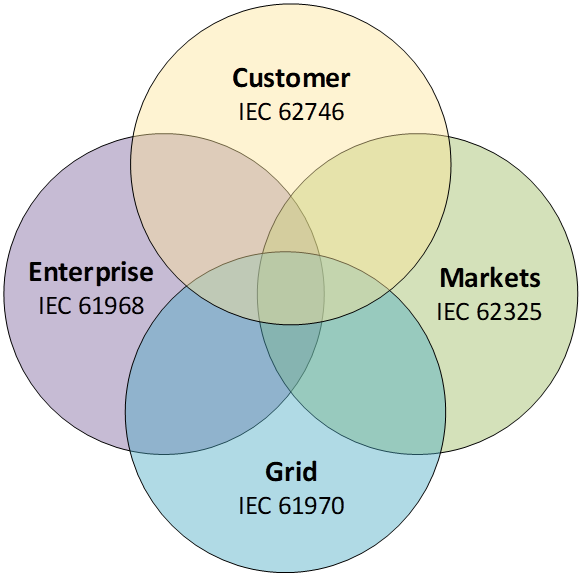
Finally, for the devices which can provide distribution grid services like local congestion management, the Market Package has been updated with all of the features needed to extend the existing wholesale market concepts to those of the virtual power plant.Since the CIM already supports demand response resources for wholesale markets which are often comprised of very small customer-owned devices not tracked by the utility, the support of local flexibility markets like those already a reality in Europe, is available. Furthermore, the need to model the operational modes and response to abnormal system conditions for inverter-based resources, as defined by IEEE 1547[11], is also embedded in the CIM.
Thus distribution-connected, customer-owned energy devices from batteries and solar inverters tracked by the utility to devices like thermostats and smart water heaters which can provide services when aggregated into a virtual power plant have all three legs. (1) The device models are available in the Enterprise Package. (2) They are mappable – when deemed important enough to be track by the utility – to physical representations in the Grid Package. And (3) When supplying services – either alone or as an aggregation – the Market Package provides the market perspective to track the economic transactions. Given the importance of this new era in power grid, a new series of CIM data exchange standards was launched to cover interfaces to the customer as the IEC 62746 series and in November of 2024, the first set of message profiles were published entitled “IEC 62746-4: Demand Side Resource Interface”[12].
[1] https://www.nerc.com/pa/RAPA/ra/Reliability Assessments DL/ERS Abstract Report Final.pdf
[2] https://www.epri.com/research/products/000000003002029927
[3] https://webstore.iec.ch/en/publication/61167
[4] https://webstore.iec.ch/en/publication/32542
[5] https://webstore.iec.ch/en/publication/31487
[6] https://assets.new.siemens.com/siemens/assets/api/aep-casestudy-intl-version.pdf
[7] https://www.epri.com/research/products/3002003053
[8] https://www.eia.gov/electricity/data/eia861/zip/f8612023.zip
[9] https://www.nerc.com/comm/RSTC_Reliability_Guidelines/Reliability_Guideline_DER_A_Parameterization.pdf
[10] https://www.epri.com/research/products/000000003002027444